Same Sideline, New Teammates: Surviving the 2026 Realignment
The 2026 Age Group Shift Explained
If you’ve finally mastered the "Birth Year" chart and can recite your child’s age group without checking your phone, take a deep breath. I have some news.
Starting in Fall 2026, youth soccer is moving the goalposts again. After a decade of the "Birth Year" experiment, the soccer world is officially shifting back to a School Year model.
Here is the breakdown of what is happening, why it’s happening, and how it affects our North Texas sidelines.
First: A Refresher on "Birth Year" (The Old Way)
Since 2017, U.S. Soccer has grouped players by the calendar year they were born (January 1 to December 31).
The Intent: Align with international standards (how the rest of the world does it).
The Reality: It split up school friends. If your kid was born in November and their best friend was born in February, they were on different teams even though they were in the same grade. This created the "Trapped Player" problem, 8th graders who couldn't play with their teammates because their team moved up to "High School" soccer while they were still in middle school.
The Big Change: Fall 2026
Beginning with the 2026-2027 season (which starts with tryouts in May/June 2026), age groups will be determined by an August 1 – July 31 window.
The Simple Rule: If your child is born between August 1 of one year and July 31 of the next year, they are in the same soccer age group.
This effectively aligns soccer "ages" with school grades for the vast majority of kids in North Texas.
Which Leagues are Making the Jump?
Almost everyone is getting on board to make life easier for families. You can expect the new August 1 cutoff in:
US Youth Soccer (USYS): This includes our local North Texas Frontier Conference
US Club Soccer: All ECNL and ECNL-Regional League teams, NPL teams, Classic League teams
Girls Academy (GA) & DPL: The leading national girls-only elite development platform. It serves as a premier alternative to the ECNL
MLS NEXT: Their Academy divisions are moving to the school-year model, though their "Homegrown" (pro-pathway) divisions may remain on a birth-year basis
How This Affects Your Team
The transition year (2026) will feel a bit like a giant game of musical chairs.
Roster Shuffles: Because the "window" is moving, some players who were the youngest on their team might now be the oldest in a different age group
Friend Reunions: Many kids who have been "playing up" just to stay with school friends will now naturally fit into their correct age group
Tryout Chaos: Let’s be real, the 2026 tryout season will be a bit more "energetic" than usual as clubs realign their pools.
The Pitch Parents Bottom Line
While change is always a little stressful, this move is designed to keep kids playing with their friends and reduce the headache of "trapped" middle schoolers. We might have to buy a new jersey or learn a new "U-level," but at least we’ll be doing it with the same group of parents we've been sharing coffee with for years.
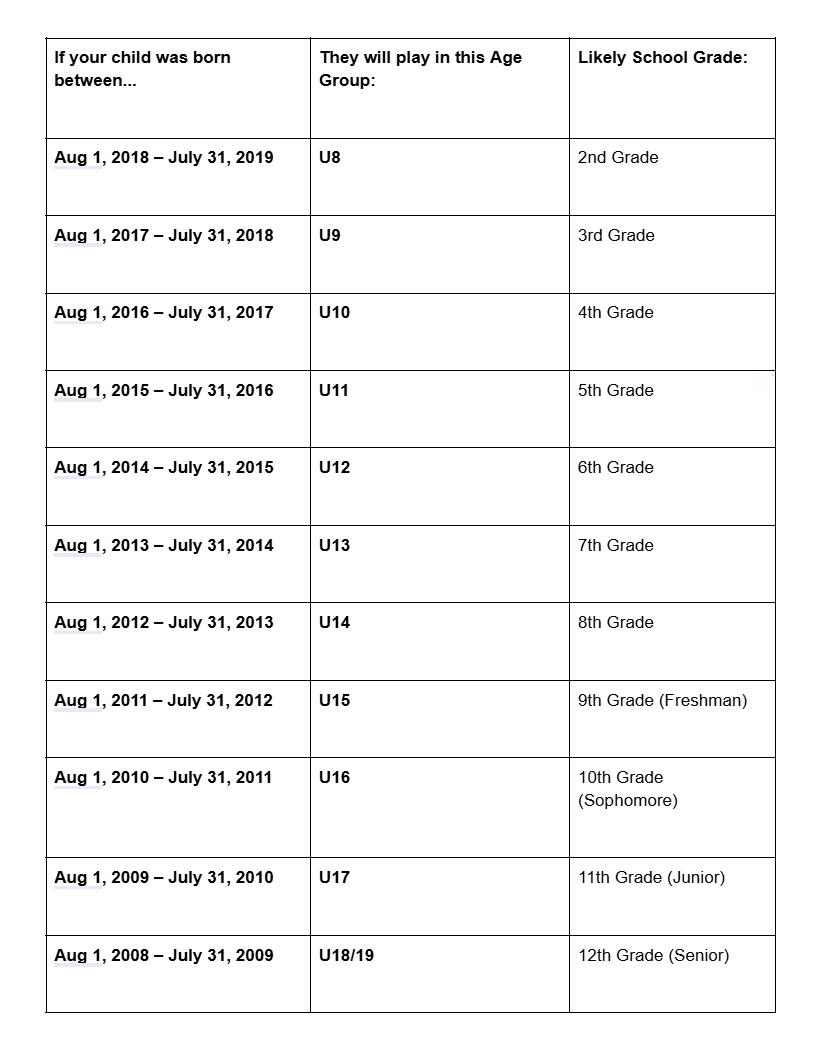
The 2026 Age Group Cheat Sheet
Starting in Fall 2026, the soccer world is moving from "Birth Year" (Jan-Dec) to "School Year" (Aug-July). Use this table to find where your player lands for the 2026-2027 Season.